
The services sector had slipped into contraction in July as confusion caused by the GST rollout triggered a dip in new business orders.

Top companies across sectors -- automobile maker Maruti Suzuki, consumer electronics giant Samsung to IT giant Infosys -- have reopened factories and offices as India took its first steps towards resuming economic activity after weeks under a near-total coronavirus lockdown.

Tata Steel was the top gainer in the Sensex pack, rallying 5.14 per cent, followed by Bharti Airtel, HDFC, TCS, L&T, SBI and Reliance Industries.

The Nikkei India Services Purchasing Managers' Index, which tracks services sector companies on a monthly basis, stood at 52 in September, down from August's 43-month high of 54.7, pointing to a slower and moderate rate of expansion.

With factory production, activities across the private sector saw the biggest drop in over three years

ICICI Bank was the top loser in the Sensex pack, shedding around 2 per cent, followed by Bharti Airtel, Axis Bank, Kotak Bank and PowerGrid. NSE Nifty closed 7.55 points or 0.07 per cent down at 11,527.45.

NSE Nifty finished higher by 46.05 points, or 0.39 per cent, at 11,707.90. Asian Paints was the top gainer in the Sensex pack, rallying 6.32 per cent, followed by Nestle India, HUL, Bajaj Auto, IndusInd Bank, Tata Steel, Maruti and PowerGrid.

The Nikkei India Services Purchasing Managers' Index, which tracks the services sector firms on a monthly basis, stood at 50.3 in February, up from 48.7 registered in January.

Currency scarcity weighed on manufacturing performance where growth of new work flows slowed
On the other hand, jobs increased for the 10th straight month in the manufacturing sector, albeit only slightly

Indian economy is likely to rebound with an 8.9 per cent growth in the fiscal year beginning April 2021 after economic activity showed significant improvement in the last quarter, IHS Markit said on Friday. The National Statistical Organisation (NSO) on Thursday predicted that the economy will contract 7.7 per cent in the current financial year ending in March, the worst performance in four decades.
While manufacturing firms cut jobs for the first time in 20 months to sharply reduce costs, services providers continued their hiring spree.

Bolstered by improved domestic demand, India's services sector expanded for the fourth consecutive month in January as business activities quickened and rising business optimism is set to sustain the growth momentum, a monthly survey said on Wednesday. The seasonally-adjusted India Services Business Activity Index rose from 52.3 in December to 52.8 in January, pointing to a quicker expansion in output. The index was above the critical 50 mark that separates growth from contraction for the fourth month in a row during January.

India will also play an increasingly important role as one of the Asia-Pacific region's major economic growth engines, helping to drive Asian regional trade and investment flows.

A reading above 50 indicates expansion, while a score below this mark means contraction

The new tax regime has also been fuelling sale of SUVs, particularly the compact SUVs

According to research by IHS Markit, for an ecosystem still grappling with infrastructure issues -- the high cost of EVs and a greater OEM (original equipment manufacturer) focus on electrifying two-wheelers and commercial vehicles first -- the share of such vehicles is expected to be 4 per cent by 2030, reports Pavan Lall.

Titan was the top gainer in the Sensex pack, rising over 3 per cent, followed by M&M, Reliance Industries, Axis Bank, TCS, Maruti and Infosys. NSE Nifty surged 122.10 points to 15,885.15.

Forex traders said a stronger dollar also dragged the rupee down.
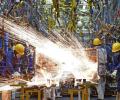
This is the ninth consecutive month that the manufacturing PMI remained above the 50-point-mark.

The Nikkei India Manufacturing Purchasing Managers' Index (PMI) stood at 47.9 in July, down from 50.9 in June, its lowest mark since February 2009, and highlighted the first deterioration in business conditions in 2017 so far.

Cars and two-wheelers attract 28% GST and a cess in the range of 3-22%, taking the effective tax rate to up to 50%.

Close to 50 models were launched in India in the past 12 months, but companies have not been able to realise their potential due to the pandemic.

Mercedes-Benz India, BMW India and Audi India have lined up over 50 new model launches as they seek to recoup previous year's loss in volumes, reports Shally Seth Mohile.

The models from Hyundai and Maruti, which might go on sale in October 2018 and February 2019, respectively, are set to revive a segment that had lost sheen to the compact SUV segment, lately

Ride-hailing firms claim penetration is still low and there is a huge upside to grow the market and make owning a car pass.

Audi's strategy seems to point to pushing technology to directly connect with consumers using digital platforms and marketing to synchromesh into one seamless experience, says Pavan Lall.

Maruti is not an online outlier, of course; other heavyweights have rolled out similar services. But as an analyst pointed out, Maruti's all-India roll-out has significant impact given that it accounts for over half of all cars sold, reports, reports Pavan Lall.

The MG Motor India management is focused on scaling up and launching smaller cars to play the long game in the country, says Pavan Lall.

For Hero MotoCorp, India's largest two-wheeler company, it's a calculated gambit to revive Harley-Davidson whose ride in India has been anything but easy since it got here.When automotive firms embark on alliances, it's a roll of the dice on how such marriages will play out.

Despite the romance around the car and its early models, Fiat in India will also be remembered as a brand that frittered away the first mover advantage, says Shally Seth Mohile.

The move is prompted by the disruption in the car usage pattern caused by the app-based ride-hailing companies such Ola and Uber
 © 2026 Rediff.com - Advertise with us - Disclaimer - Privacy Policy - Sitemap - Feedback - About us - Terms of use - Grievances